Since I was diagnosed with incurable prostate cancer in May 2017 and given a worst-case prognosis of 2-3 years, I’ve constantly felt at odds with the “establishment” about screening for prostate cancer. The “establishment” tells us that screening causes more harm than it does good because, historically, men were radically treated, with prostatectomies or radiotherapy, for low-risk cancer that would probably never cause them a problem. Some of those men were left incontinent and/or impotent, either partly, short term or permanently. I’m sure those men are truly troubled by the harms they have suffered but I find it hard to accept that they would have preferred the cancer to have been left untreated!
The diagnostic and treatment pathways have of course moved on and men with low grade prostate cancer should, typically, not receive radical treatment but, instead, go onto Active Surveillance (AS) where their prostate cancer is carefully monitored and radical treatment only considered when the cancer is showing signs of progression and more radical treatment might be needed. Thus, any side effects of treatment are deferred and quality of life maintained for as long as possible.
The ProtecT trial showed that, after 15 years, the outcomes from AS compared to radical treatment were broadly the same thus confirming that AS is an appropriate treatment option for men with low-risk prostate cancer.
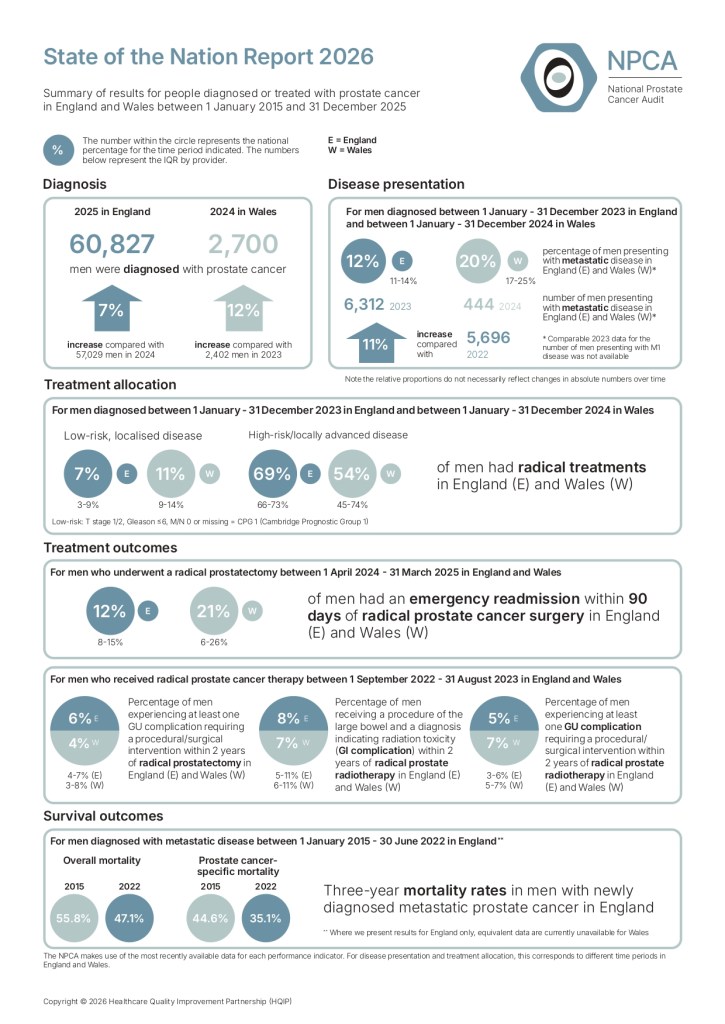
Every year the National Cancer Audit Collaborating Centre (NATCAN) produce the National Prostate Cancer Audit (NPCA) that allows us to look at key numbers around prostate cancer diagnoses and treatments, albeit a couple of years down the line.
Using the numbers for England only, we can see that the number of men diagnosed in 2025 rose 7% to 60,827, the first time the number has exceeded 60,000 in England alone.
NPCA shows that, in 2023, of the 51,389 men diagnosed, 6,312 were metastatic at diagnosis. It also shows that, of 6,000 with low-risk Cambridge Prognostic Group 1 (CPG1), the lowest grade of prostate cancer, 418 men had radical treatment instead of AS which is c. 7%.
Looking a little behind that 7% we see that some NHS trusts have much higher %’s of men having radical treatment instead of AS with 13 trusts in double figures with a worst of 18.4%. Clearly, there is more work to be done to get consistency across all NHS trusts and avoid potentially harming men with low grade cancer.
We rightly worry about harming men through unnecessary treatment. But we must also confront the harm of finding prostate cancer too late. After decades of debate, men deserve a transparent account of how those competing risks are being balanced.
I find it hard to accept that avoiding a few hundred men having issues because of radical treatment they didn’t need, is a price worth paying for the 6,312 men diagnosed too late.
At the heart of my frustration is the fact that the screening debate has barely moved forward in 25 years and I see the risk of another generation of men being diagnosed too late while the evidence threshold keeps the policy effectively unchanged.
Just to encapsulate the impact of late diagnosis in a few words. The treatment has grotesque, life changing consequences and you are still highly likely to die prematurely unless something else kills you first!
How many cases of metastatic prostate cancer could be prevented by a screening pathway that uses modern MRI, risk assessment and active surveillance to minimise unnecessary treatment — and how does that compare with the harms of screening? The TRANFORM trial may well tell us but when?
Every year we delay effective prostate cancer screening; more men will be diagnosed with incurable disease. Over the next 10–15 years that it may take TRANSFORM to produce evidence that the National Screening Committee (NSC) might accept, the cumulative number of deaths will be enormous given that 12,000 men die in the UK every year. Of course, screening will not prevent every one of those deaths but if even a proportion could be prevented by detecting aggressive cancers earlier, how many lives are we prepared to risk losing while we wait for evidence that may take another decade to mature?
The answer should not be to abandon scientific rigour. It should be to pursue the evidence urgently, introduce carefully monitored risk-based screening where the case is strongest, and review the results as they emerge.
The NSC has declined to approve screening apart from for a tiny cohort of men that it’s currently impossible to find because we don’t test for the BRCA2 genetic mutation. I believe that there are therefore three questions the NSC should answer transparently and immediately:
- What evidence would actually change its recommendation? If the answer is not sufficiently specific, it is difficult for the public to know what success looks like.
- How will it account for the cost of waiting? Its assessment should consider not only the harms of screening but also the deaths and suffering that earlier diagnosis might prevent.
- Can targeted screening begin while longer-term evidence accumulates? The case for a monitored programme among higher-risk men is different from the case for inviting every man in the population!

